cost data
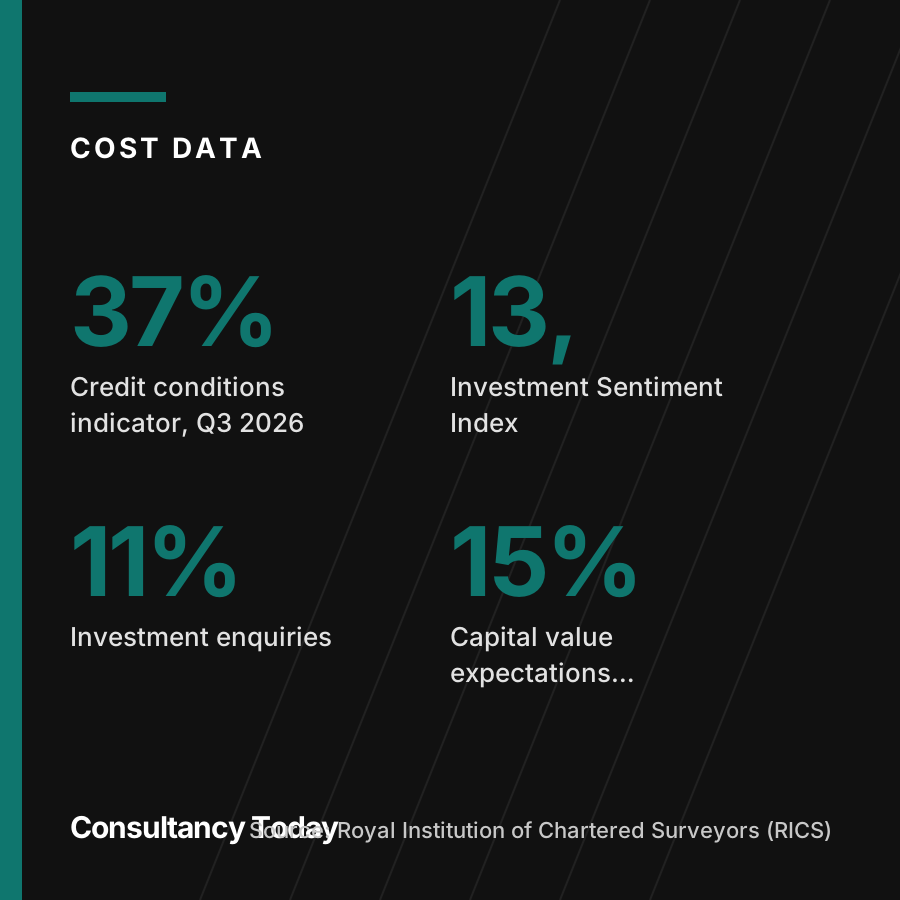
Glenigan cuts 2026 outlook to a 13% fall in starts, with an 11% rebound forecast for 2027
The data firm's Winter 2026 forecast is far weaker than the near-flat year it predicted in June, with private housing starts down 24% and civils down 9%, before public programmes and utilities drive a recovery.
Glenigan has cut its outlook for UK construction, forecasting a 13% fall in project starts in 2026 before a recovery of 11% in 2027 and a further 7% in 2028, in its Winter 2026 forecast published on 10 November.
The data provider said the picture is weaker than its Summer forecast, which it described as having predicted a 1% dip this year. Glenigan's June forecast article itself said underlying starts, meaning projects valued under £100m, would "dip slightly" in 2026 before rising 11% in 2027 and 4% in 2028.
Glenigan attributed the downgrade to the prolonged conflict in the Middle East, which it said had pushed up energy prices, inflation and borrowing costs and weighed on investment decisions across the industry.
The forecast follows hard data pointing the same way. Glenigan's index to the end of October 2026 recorded the value of work starting on site over three months down 9% on the preceding period and 21% below a year earlier. Civils work bucked the trend, rising 21% against the preceding three months and standing 19% above the previous year.
Allan Wilén, Glenigan Economics Director, said of the October figures: "a rise in civil engineering work should not go unnoticed as a number of important utilities projects get off the ground."
Sector by sector
Private housing is the hardest hit sector in the Winter forecast. Glenigan expects a sluggish housing market, higher mortgage rates and rising development costs, including building safety requirements, to drive a 24% fall in starts this year. It forecasts a gradual recovery from mid-2027, but activity still below 2025 levels at the end of 2028. In June, Glenigan had forecast underlying private housing starts to rise 13% in 2027.
Industrial starts are forecast to fall 14% in 2026 as investors defer projects. The Summer forecast had pencilled in a 9% fall this year and a 16% rise in 2027.
Offices are the exception among private sectors. Glenigan expects starts to hold steady this year, then rise 11% in 2027 and 8% in 2028, supported by demand for high-quality, sustainable space, refurbishment and new data centres. Hotel and leisure is expected to slip back before returning to growth in 2028.
| Sector (Glenigan Winter 2026 forecast) | 2026 | 2027 | 2028 |
|---|---|---|---|
| All project starts | -13% | +11% | +7% |
| Private housing | -24% | recovery from mid-2027 | below 2025 levels |
| Industrial | -14% | not stated | not stated |
| Offices | steady | +11% | +8% |
| Education | +1% | +9% | not stated |
| Health | +1% | +11% | not stated |
| Civil engineering | -9% | +11% | +10% |
Public programmes and utilities
Glenigan said increased capital funding from the Spending Review had been slower than expected to turn into starts, with education and health each forecast to edge up by only 1% this year. In June it had expected underlying education starts to rise 8% in 2026 and 20% in 2027; the Winter forecast now puts education growth at 9% in 2027 and health at 11%, as the School Rebuilding Programme and New Hospital Programme progress to site.
The Department for Education said by December 2022 that 400 of the 500 schools and sixth forms in the ten-year School Rebuilding Programme had been selected. The Department of Health and Social Care's plan for the New Hospital Programme puts wave 1 schemes on site between 2025 and 2030 and wave 2 between 2030 and 2035, with investment rising to up to £15bn over each five-year wave, averaging about £3bn a year from 2030.
Civil engineering starts are forecast to fall 9% in 2026, a second successive annual decline, before rising 11% in 2027 and 10% in 2028. In June the 2027 figure for underlying civils starts was 15%. Glenigan expects utilities to be a consistent source of growth, citing the AMP8 water investment cycle, renewable generation and electricity network upgrades.
The economic backdrop
Glenigan said consumer price inflation rose to 3.3% in August and is expected to peak above 4% early in 2027, with earnings growth at its weakest since 2020. The Office for National Statistics' August 2026 bulletin put the Consumer Prices Index (CPI) at 3.1%; 3.3% was its figure for CPIH, the measure including owner occupiers' housing costs. Glenigan forecasts UK economic growth of about 1.2% in 2027 and 1.4% in 2028.
In its response to the Chancellor's Budget on 28 October, Glenigan pointed to measures it expects to support the housing recovery. Wilén said: "Helping people with their deposits should bring more buyers into the market." He also said fiscal discipline in the Budget should help protect capital funding and ease pressure on government borrowing costs, and that deferring building regulation changes for the rest of this Parliament gives developers more certainty.
On accelerated defence spending, he said it could open opportunities for construction but that a large share would go on equipment rather than buildings.
Glenigan, part of Byggfakta Group and an official provider of UK and Northern Ireland construction data to the ONS, said its forecast summary was prepared with AI assistance and reviewed by its economics team. The full Winter 2026 forecast covers the value of starts by sector to 2028.
On the record: Glenigan, Department for Education
Sources
- Glenigan (opens in a new tab) (accessed 2026-11-11)
- Glenigan (opens in a new tab) (accessed 2026-11-11)
- Glenigan (opens in a new tab) (accessed 2026-11-11)
- Glenigan (opens in a new tab) (accessed 2026-11-11)
- Glenigan (opens in a new tab) (accessed 2026-11-11)
- Office for National Statistics (opens in a new tab) (accessed 2026-11-11)
- Department of Health and Social Care (GOV.UK) (opens in a new tab) (accessed 2026-11-11)
- Department for Education (GOV.UK) (opens in a new tab) (accessed 2026-11-11)
This story was researched from the primary sources above and checked against them before publication. Spotted an error? Tell us and we will correct it promptly.