cost data
Montagu Evans warns London office starts fall to 1.67m sq ft against 2.05m sq ft annual need
The property consultancy's research says Central London needs at least 20.5m sq ft of new offices over ten years, yet starts have slumped and the draft London Plan could add to viability pressures.

Montagu Evans has warned that work started on just 1.67m sq ft of Central London office space in the year to Q2 2026, well below the 2.05m sq ft a year it estimates the capital needs to house forecast job growth.
The UK property consultancy published the research on 21 October under the title "London's worsening shortage of prime offices should be a national concern". Its author is Jon Neale, Director of Research & Insight at the firm, who sits on its Executive Committee and has more than 20 years of experience in real estate research and strategy.
The report also says that starts over the past year were well below the 10-year average of about 3m sq ft a year. Over a longer time frame, development starts had been running about 3% above that average, but activity has fallen since 2024, with what Montagu Evans describes as a noticeable drop over 2026 in particular.
The demand case
Montagu Evans bases its 20.5m sq ft figure on employment forecasts from Oxford Economics, which it cites as predicting 190,000 new office-based jobs, a 16% rise, in Camden, Westminster and the City over the ten years to 2034. Within that, the Information & Communication sector is forecast to add 64,000 jobs, up 24%. Assuming 108 sq ft per new job gives the ten-year requirement.
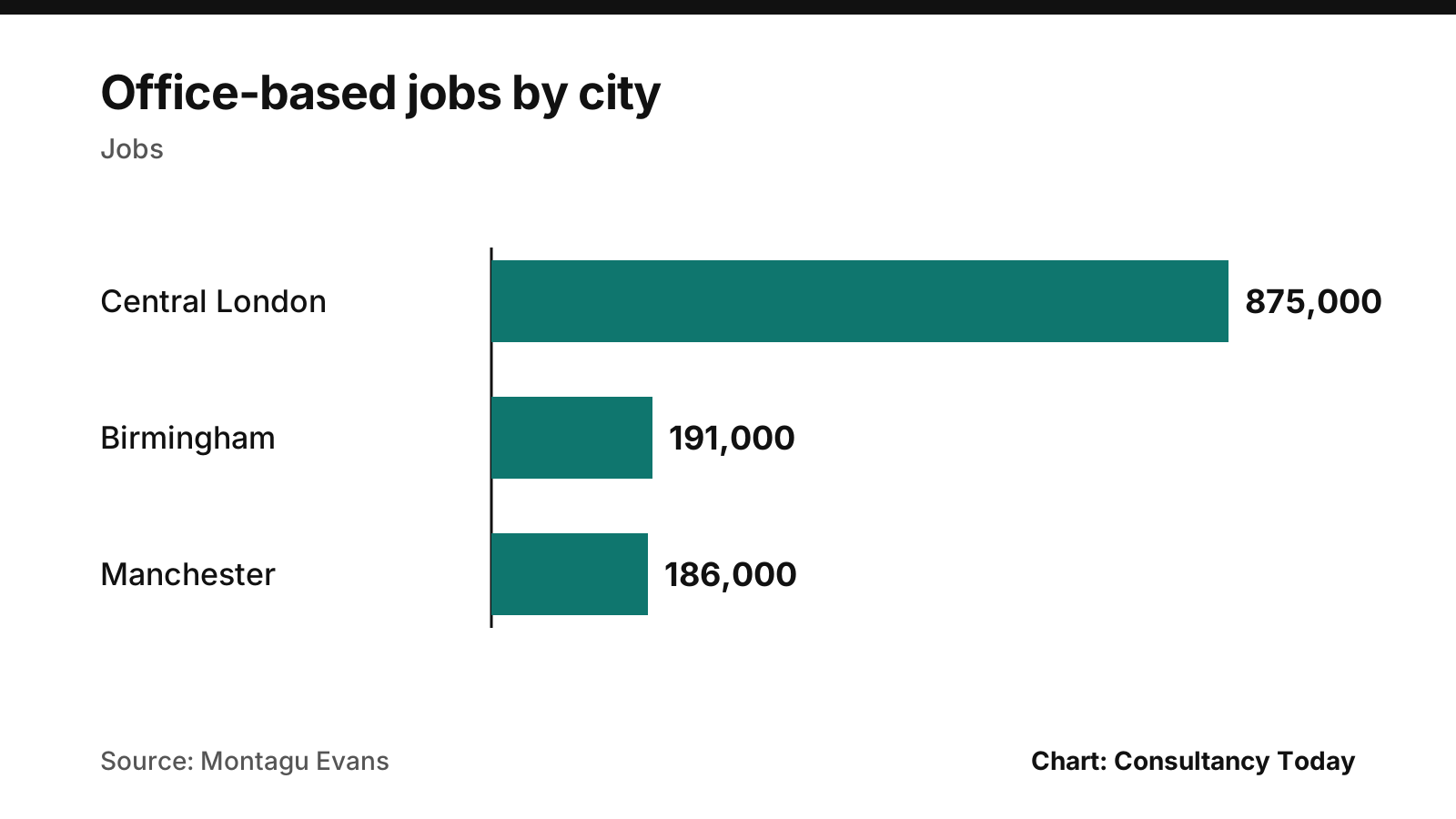
The consultancy argues that Central London's economic weight justifies national attention. It puts the area's office-based jobs at about 875,000, against 191,000 in Birmingham and 186,000 in Manchester.
| City | Office-based jobs |
|---|---|
| Central London | 875,000 |
| Birmingham | 191,000 |
| Manchester | 186,000 |
Occupier demand has held up, according to the report. Comparing average take-up over the three years to Q1 2026 with the five pre-pandemic years, London fell back by only 1.3%, against more than 8% in Manchester and more than 15% in most other major cities. Net absorption has been positive since early 2025, with about 3m sq ft more space occupied at the end of Q2 than a year earlier.
Rents reflect the squeeze, the report says. Citing MSCI, it puts rental growth over the past 12 months at 10.6% in the City and 5.3% in the West End, the highest of any UK property segment.
Vacancy and viability
Headline vacancy rates of 11.2% in the City and 8.2% in the West End are reasonably high by historic standards, Montagu Evans says, but it argues that much of the available space is unsuitable. Citing CoStar, it says about 85% of currently available Central London space is in buildings more than 10 years old.
On the supply side, the report points to cost pressures. Citing the Office for National Statistics, it says commercial construction costs rose 23% over the five years to March 2026.
The slowdown in starts has come despite about 21m sq ft of office space either seeking consent or approved but unstarted, according to the report. Planning applications are also falling: citing Glenigan data, Montagu Evans says applications for 3.1m sq ft of offices were received in the City and Westminster in the year to Q2 2026, down from 7.7m sq ft in the previous 12 months.
City and West End diverge
The report identifies an imbalance between the two core markets. Over the two years to the end of Q2 2026 there were 2.7m sq ft of office starts in the West End but only 1.8m sq ft in the City, even though net absorption over the past year was about 448,000 sq ft in the City against about 228,000 sq ft in the West End.
Citing CoStar, Montagu Evans says about 15.5m sq ft of offices are applied for or consented but unstarted in the City, compared with 5.8m sq ft in the West End. The firm says this imbalance explains why rents have risen twice as fast in the City over the past year.
Planning policy
Montagu Evans says the draft London Plan recognises the need for new workspace but that its emphasis on affordable workspace requirements could add further pressure to scheme viability. It also warns that more restrictive policies on tall buildings would further challenge London's ability to provide office space.
The firm argues the short-term response should be about enabling more refurbishment and repositioning rather than waiting for a full newbuild recovery. It calls for planning policy to incentivise and enable change of use where offices are no longer viable, and says planners need to avoid placing additional burdens on office developers.
Montagu Evans describes itself as a UK property consultancy specialising in high-value, complex assets, with Central London one of its four stated focus areas.
The report concludes that unless capital conditions improve or regulation lightens, the likely outcome is a tighter market.
Sources
- Montagu Evans (opens in a new tab) (accessed 2026-10-22)
- Montagu Evans (opens in a new tab) (accessed 2026-10-22)
- Montagu Evans (opens in a new tab) (accessed 2026-10-22)
This story was researched from the primary sources above and checked against them before publication. Spotted an error? Tell us and we will correct it promptly.