cost data
Two in five AI-using builders now prepare quotes and tenders with it, FMB and CIOB survey finds
The H1 2026 State of Trade Survey records rising AI use in estimating and tendering while net balances for workloads, enquiries and employment all turned negative.

Two in five construction businesses already using artificial intelligence are applying it to quotes, estimates and tenders, according to the H1 2026 State of Trade Survey published on 10 November by the Federation of Master Builders (FMB) and the Chartered Institute of Building (CIOB).
The survey found 57% of construction businesses were using AI technologies more than a year earlier, while 22% said they were not using AI at all. The CIOB described the gap as a growing digital divide across the sector.
Among firms using AI, 80% deploy it for administration and office tasks, 42% use it to prepare quotes, estimates and tenders, and 33% apply it in site operations, health and safety and quality management.
Brian Berry, Chief Executive of the FMB, said: "These figures show that AI is becoming a more established part of how construction firms run their businesses, particularly for administration, tender preparation and project management. But technology is not a silver bullet".
Trading indicators turn negative
The take-up of AI in estimating comes as demand weakens. The CIOB reported net balances of -4% for workloads, -10% for enquiries and -4% for employment in the first half of 2026, covering January to June.
All three measures were positive in the previous edition. In H2 2025, the CIOB reported net balances of +22% for workloads, +17% for employment and +18% for enquiries. In H1 2025 the net employment change was +26%, which the FMB said at the time was the strongest improvement since Q1 2010.
The picture varied by nation. Scotland recorded the strongest net workload balance at +31%, Wales +14% and England -9%. Around three in ten house-building and repair, maintenance and improvement (RMI) businesses reported increased workloads, and enquiries rose for 28% of RMI businesses and 21% of house builders.
Skills and costs
Skills shortages affected 68% of businesses, down from 72% in H2 2025 but above the 61% recorded in H1 2025. Of those affected in the latest survey, 47% reported delayed jobs, 29% restricted recruitment, 21% cancelled jobs and 18% said they were prevented from growing or expanding.
Among firms recruiting, 45% struggled to find staff with knowledge of modern sustainable building practices and 37% struggled to find people with knowledge of the building safety regime.
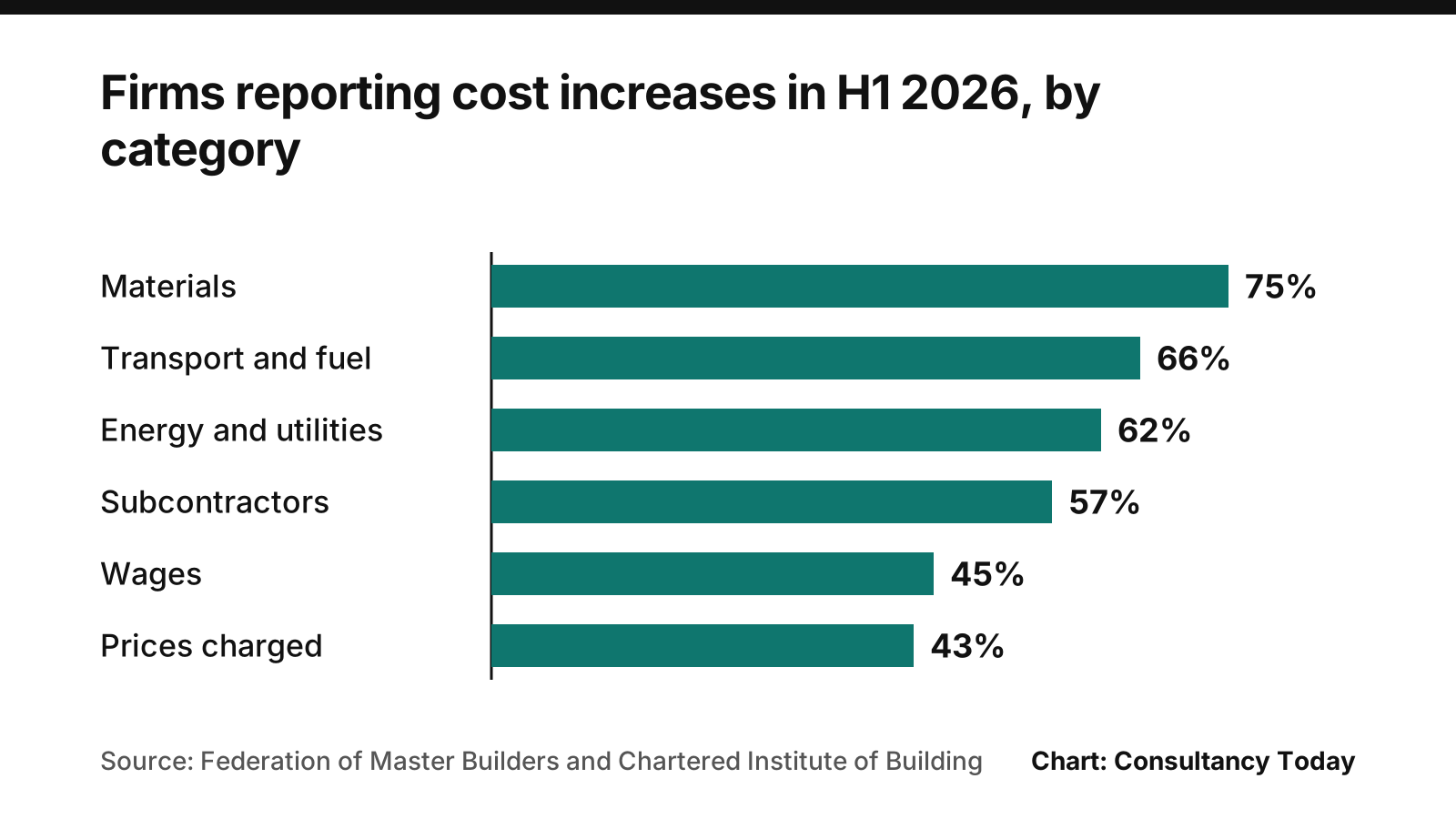
Cost pressure remained widespread. Three-quarters of businesses reported higher material costs, the same proportion as in the H2 2025 edition. The survey recorded the following cost increases:
| Cost category | Firms reporting an increase |
|---|---|
| Materials | 75% |
| Transport and fuel | 66% |
| Energy and utilities | 62% |
| Subcontractors | 57% |
| Wages | 45% |
| Prices charged | 43% |
In response, 48% of businesses increased prices and 47% reported lower-than-expected profits or a loss. A further 29% restricted recruitment, 16% made redundancies or terminated contracts and 14% reported an impact on viability.
Dr Victoria Hills, Chief Executive of the CIOB, said: "The construction sector continues to be an industry where many SMEs have to fight to survive and this has to change."
She said government announcements on V-levels, vocational GCSEs and more apprenticeships were welcome but that more detail was urgently needed on what they would look like. Berry called on the Government to give small firms practical support to navigate new technology and grow their businesses.
Weather delays and outlook
One in five businesses (20%) reported project or job delays linked to extreme weather, including heatwaves and rainfall. Hills said climate resilience needed to be higher on the industry's agenda and that the impact of the summer's prolonged hot weather would be covered in the next State of Trade report.
Looking ahead, 39% of businesses were positive about the second half of 2026, 32% neutral and 23% negative, giving a net outlook balance of +16%. In the H2 2025 survey, 48% had been positive about H1 2026.
About the survey
The FMB said the H1 2026 edition is based on 416 responses, compared with 493 for H2 2025 and 458 for H1 2025. The CIOB describes the State of Trade Survey as the only survey of its kind focused exclusively on small and medium-sized firms, and the FMB said it has tracked key indicators for more than 30 years and is published twice a year.
The full H1 2026 report is available as a PDF download on the CIOB research page.
On the record: Federation of Master Builders, Chartered Institute of Building
Sources
- Chartered Institute of Building (opens in a new tab) (accessed 2026-11-10)
- Federation of Master Builders (opens in a new tab) (accessed 2026-11-10)
- Chartered Institute of Building (opens in a new tab) (accessed 2026-11-10)
- Federation of Master Builders (opens in a new tab) (accessed 2026-11-10)
- Chartered Institute of Building (opens in a new tab) (accessed 2026-11-10)
- Federation of Master Builders (opens in a new tab) (accessed 2026-11-10)
This story was researched from the primary sources above and checked against them before publication. Spotted an error? Tell us and we will correct it promptly.