cost data
RICS Q3 monitor shows commercial property credit tightening again as investment sentiment slips
The Royal Institution of Chartered Surveyors' Q3 2026 UK Commercial Property Monitor records a renewed squeeze on lending, weaker investment enquiries and softer capital value expectations, unwinding the improvement reported in Q2.
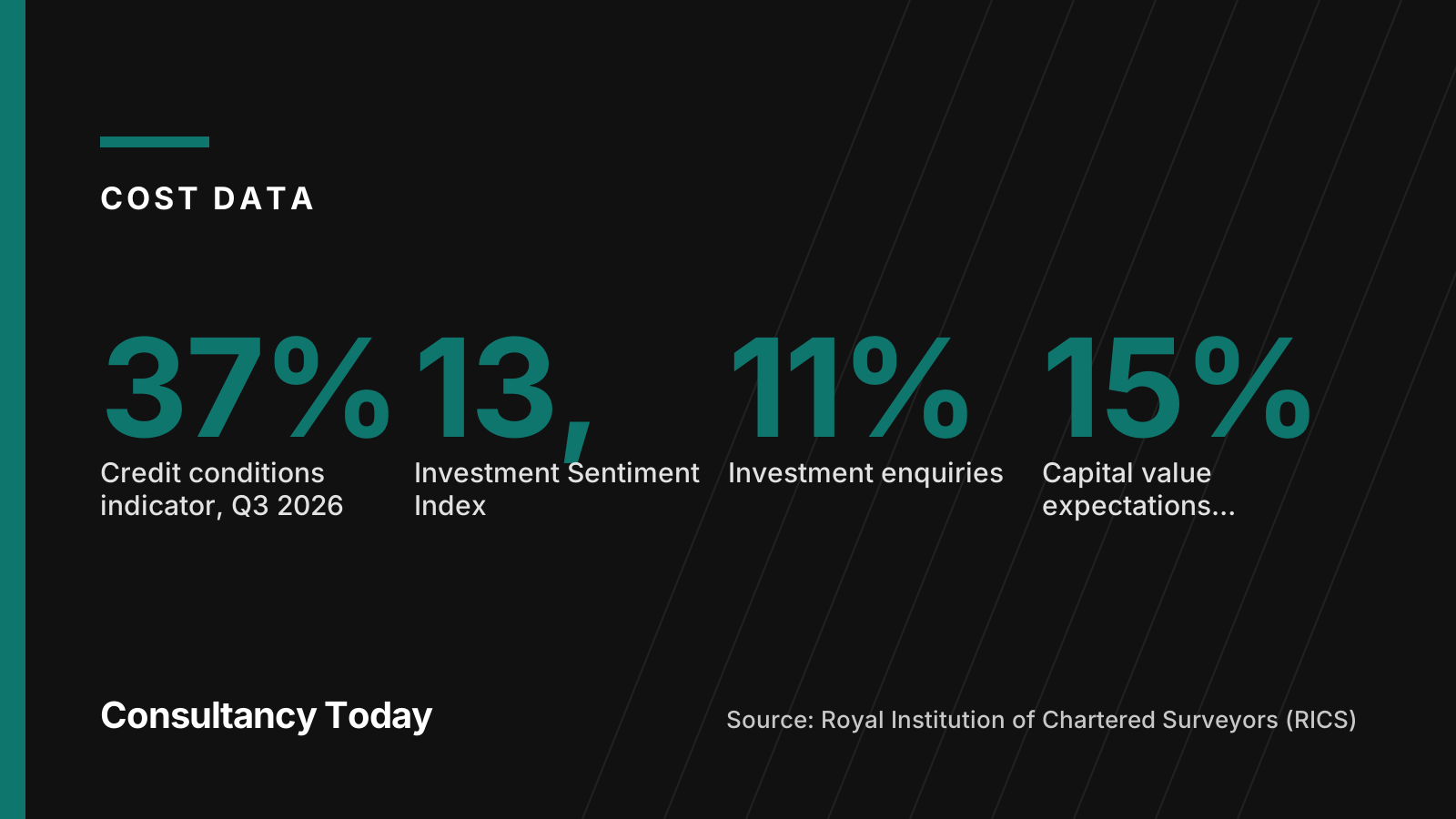
UK commercial property lending conditions tightened again in the third quarter, the Royal Institution of Chartered Surveyors (RICS) said, with its credit conditions indicator falling to a net balance of -37% from -23% in Q2.
The reading, published on 28 October 2026 in the Q3 2026 UK Commercial Property Monitor, reverses the picture RICS painted three months earlier. Its Q2 release, published on 30 July 2026, said the sharp tightening in credit conditions seen earlier in the year was starting to unwind.
RICS said higher borrowing costs and tighter lending conditions were weighing on the investment market. Its Investment Sentiment Index declined to -13 from -8, and most respondents now view the market as being in a downturn.
Tarrant Parsons, Head of Market Research and Analysis at RICS, said the survey pointed to a more challenging backdrop, with "the investment side bearing the brunt of higher borrowing costs following the recent rise in gilt yields to their highest levels in almost two decades."
The credit picture
RICS's credit conditions indicator has swung sharply over the past year, according to its quarterly releases.
| Quarter | Credit conditions net balance |
|---|---|
| Q4 2025 | +9% |
| Q1 2026 | -44% |
| Q2 2026 | -23% |
| Q3 2026 | -37% |
The Bank of England's own Q3 2026 Credit Conditions Survey, which canvasses lenders rather than surveyors, gave a different reading. Lenders reported that the overall availability of credit to the corporate sector was unchanged in Q3, although credit availability to small and medium-sized businesses decreased. Lenders expected overall corporate credit availability to be unchanged again in Q4.
The Bank's Monetary Policy Committee held Bank Rate at 3.75% at its September 2026 meeting. The next decision is due on 5 November 2026.
Investment and values
Investment enquiries weakened to a net balance of -11% from -8%, RICS said, giving back the improvement from -11% to -8% it recorded in Q2. Overseas investment demand was negative across offices, retail and industrial property for a fifth consecutive quarter.
Expectations for capital values over the next three months fell to a net balance of -15% from -11%. Industrial property expectations moved into negative territory, and retail recorded the weakest outlook of the three mainstream sectors.
Parsons said: "In contrast, sentiment towards secondary assets has weakened further, highlighting an increasingly pronounced divergence in performance across the market."
Occupiers and rents
The occupier side held up better, according to RICS. Overall tenant demand slipped to a net balance of -8% from -5%, broadly back to the -8% recorded in Q1 2026. Industrial demand was close to flat, while office and retail demand stayed negative.
Respondents still expect rents to rise for better-quality space over the coming year. Prime office rental expectations returned a net balance of +41% and prime industrial +38%. Both eased from Q2, when RICS reported +51% for prime offices and +45% for prime industrial, but remain positive. Rents for secondary offices and retail premises are expected to fall.
London was the only region to record a positive occupier demand balance, at +4%. Prime office rental expectations in the capital were +64%, down from +67% in Q2. Prime industrial rental expectations were +54% in the North of England and +46% in the Midlands.
Among alternative sectors, data centres led expectations for both rental and capital value growth with net balances of +58% for each, below the readings exceeding +65% RICS reported in Q2. Aged care facilities and multifamily housing kept positive outlooks, while student housing capital value expectations weakened to -14%.
What else is coming
Surveyors advising on commercial leases are also awaiting the removal of upwards-only rent reviews in England and Wales under the English Devolution and Community Empowerment Act 2026, which received Royal Assent on 29 April 2026. RICS has described the change as a fundamental rebalancing of rights between landlords and tenants, and said no implementation is expected before 2027 at the earliest.
Sources
- RICS (opens in a new tab) (accessed 2026-10-29)
- RICS (opens in a new tab) (accessed 2026-10-29)
- RICS (opens in a new tab) (accessed 2026-10-29)
- Bank of England (opens in a new tab) (accessed 2026-10-29)
- Bank of England (opens in a new tab) (accessed 2026-10-29)
- RICS (opens in a new tab) (accessed 2026-10-29)
This story was researched from the primary sources above and checked against them before publication. Spotted an error? Tell us and we will correct it promptly.