cost data
RICS Q3 monitor shows workloads at -7% as credit outlook and housing weaken
The Royal Institution of Chartered Surveyors' Q3 2026 UK Construction Monitor records a sixth negative quarter for workloads, with private housing at -18% and short-term credit expectations falling to -36%.

Construction workloads fell for a sixth consecutive quarter in the three months to September, the Royal Institution of Chartered Surveyors (RICS) said on 5 November, as housing activity weakened and respondents grew more worried about the cost and availability of finance.
The headline workloads net balance in the Q3 2026 UK Construction Monitor was -7%, down from -4% in Q2. RICS describes the monitor as a sentiment indicator drawing on input from its professionals; a negative reading means more respondents reported falling workloads than rising ones.
Private housing was the weakest sector at -18%, from -12%, while public housing moved into negative territory at -6%, from +1%. Private commercial slipped to -10%, from -7%, and private industrial was -7%, which RICS said was a slight improvement on the previous quarter.
Simon Rubinsohn, RICS Chief Economist, said: "RICS data continues to show the financial pressures on housebuilders as the key factor holding back development with increased regulatory costs significantly impacting viability alongside rising material prices."
Workloads by sector
| Sector (Q3 2026 net balance) | % |
|---|---|
| Private housing | -18 |
| Private commercial | -10 |
| Private industrial | -7 |
| Public housing | -6 |
| Infrastructure | +18 |
Source: RICS UK Construction Monitor Q3 2026
Credit and constraints
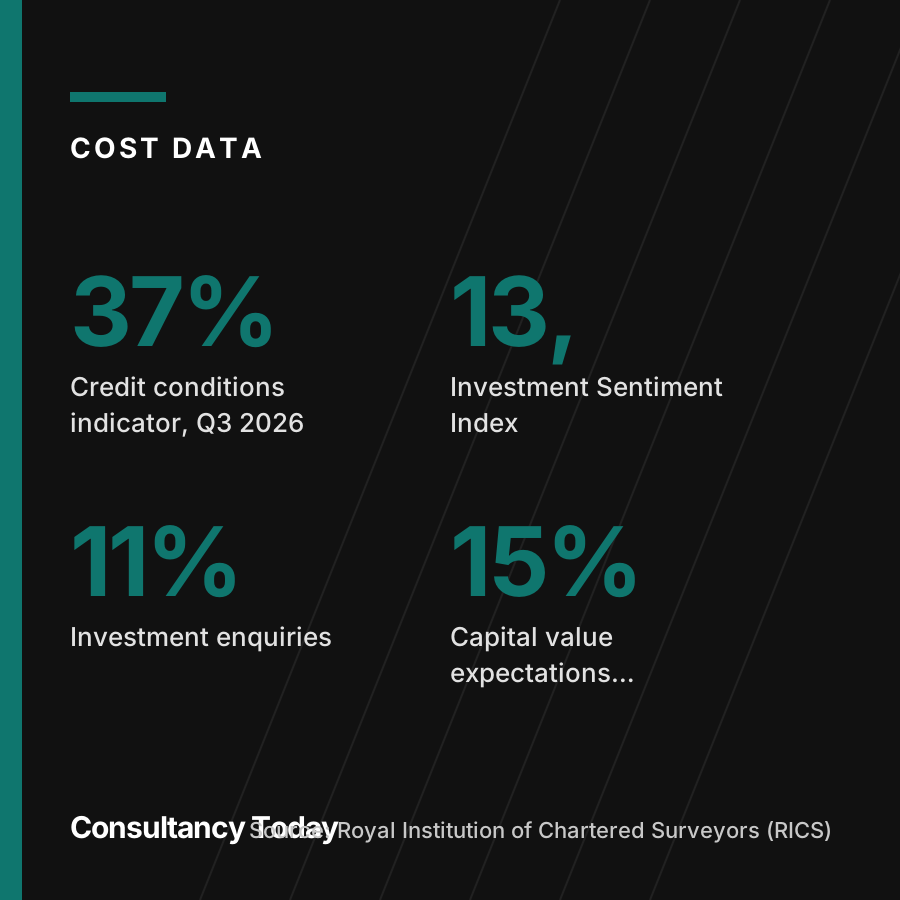
Respondents became markedly more cautious about financing. The net balance for credit conditions over the next three months fell to -36%, from -21%, and the 12-month outlook weakened to -32%, from -13%. RICS said survey feedback linked these concerns to rising gilt yields during the quarter and the associated increase in borrowing costs.
Financial constraints and planning and regulation were each cited by 62% of respondents as factors limiting activity. Contributors again pointed to Building Safety Regulator approval timescales, nutrient neutrality and biodiversity net gain (BNG) requirements as sources of delay. Insufficient demand was cited by 41% and labour shortages by 36%.
Separately, HM Treasury's Budget 2026 release of 28 October said smaller housing developments on brownfield land would be exempted from BNG requirements.
The credit figures have swung through the year. RICS's Q1 monitor, published in May, put three-month credit expectations at -51% and recorded 66% of respondents citing financial constraints, with Rubinsohn saying at the time that the impact of the war in the Middle East was clearly visible in the data. The headline workloads balance in Q1 was -12%, before improving to -4% in Q2.
Infrastructure outperforms
Infrastructure workloads rose to +18%, from +16%, the strongest reading in eight quarters and a recovery from +4% in Q1. Energy was the strongest subsector at +37%, water and sewage rose to +30% from +23%, and roads improved to +12% from +7%.
Infrastructure also led 12-month expectations at +35%, against +5% for private residential and +10% for private non-residential work. The headline 12-month workloads expectation was broadly unchanged at +12%, from +13%, and employment expectations edged up to +15%.
Costs and margins
Profit margin expectations deteriorated to -13%, from -10%. Rubinsohn said: "Critically, the results point to the pressure on profit margins remaining intense through the course of 2027, which will likely compel developers to remain highly selective in their focus."
Cost expectations eased for a second quarter but remain elevated by historical standards, RICS said. Respondents expect materials costs to rise by 6.5% over the next year, overall construction costs by 5.8% and tender prices by 5.0%. In Q1, the equivalent forecasts were 7.5% for materials and 6.6% for construction costs.
Housing context
Official output data points the same way. The Office for National Statistics said on 15 October that total construction output in Great Britain fell 1.0% in the three months to August 2026, the second consecutive three-monthly decrease, with new work down 1.4% and repair and maintenance down 0.3%. Private new housing was the main negative contributor, falling 3.2% over the period and 1.9% in August alone.
RICS's September Residential Market Survey, published 8 October, reported new buyer enquiries at a net balance of -22%, from -18% in August, and a headline house price balance of -32%, from -28%, which RICS attributed to higher interest rate expectations.
Rubinsohn said the government's Your First Home scheme, while welcome, could not alone improve a housing pipeline running below what the government had projected. The Ministry of Housing, Communities and Local Government says the scheme is designed to help first-time buyers purchase a new-build home with a smaller deposit and mortgage, and the Budget release said it would help 70,000 people onto the property ladder.
He also said challenges in securing planning permission persisted despite the Planning and Infrastructure Act, which he said had improved approval and response times. The Act became law on 18 December 2025, with the government saying its changes would speed up major infrastructure projects by 12 months on average and inject up to £7.5bn into the economy over the next decade.
Your First Home is expected to open for applications in February 2027.
On the record: Ministry of Housing, Communities and Local Government
Sources
- RICS (opens in a new tab) (accessed 2026-11-06)
- RICS (opens in a new tab) (accessed 2026-11-06)
- RICS (opens in a new tab) (accessed 2026-11-06)
- RICS (opens in a new tab) (accessed 2026-11-06)
- Office for National Statistics (opens in a new tab) (accessed 2026-11-06)
- Ministry of Housing, Communities and Local Government (GOV.UK) (opens in a new tab) (accessed 2026-11-06)
- HM Treasury (GOV.UK) (opens in a new tab) (accessed 2026-11-06)
- Ministry of Housing, Communities and Local Government (GOV.UK) (opens in a new tab) (accessed 2026-11-06)
This story was researched from the primary sources above and checked against them before publication. Spotted an error? Tell us and we will correct it promptly.