legal and regulation
DESNZ publishes working-day timetable for Post-Consent Unit on nuclear and grid DCOs
Guidance published on 27 October sets validation and consultation periods for discharging requirements on nuclear and electricity transmission development consent orders, with no fee currently payable and fees intended from 2027-28.
The Department for Energy Security and Net Zero (DESNZ) has published guidance on how its Post-Consent Unit will handle applications to discharge requirements on nuclear and electricity transmission development consent orders, with a working-day timetable.
The policy paper, published on 27 October 2026, covers how the unit, known as the PCU, will manage post-consent discharge applications and how stakeholders should engage with the process, DESNZ said.
According to the guidance, the PCU was set up in response to Recommendation 30 of what the document calls the Nuclear Task Force Review. The department's stated priority for the unit is to deliver the post-consent discharge process robustly and at pace.
John Fingleton, Taskforce Chair, said when the review's final report was published: "This is a once in a generation opportunity."
The timetable
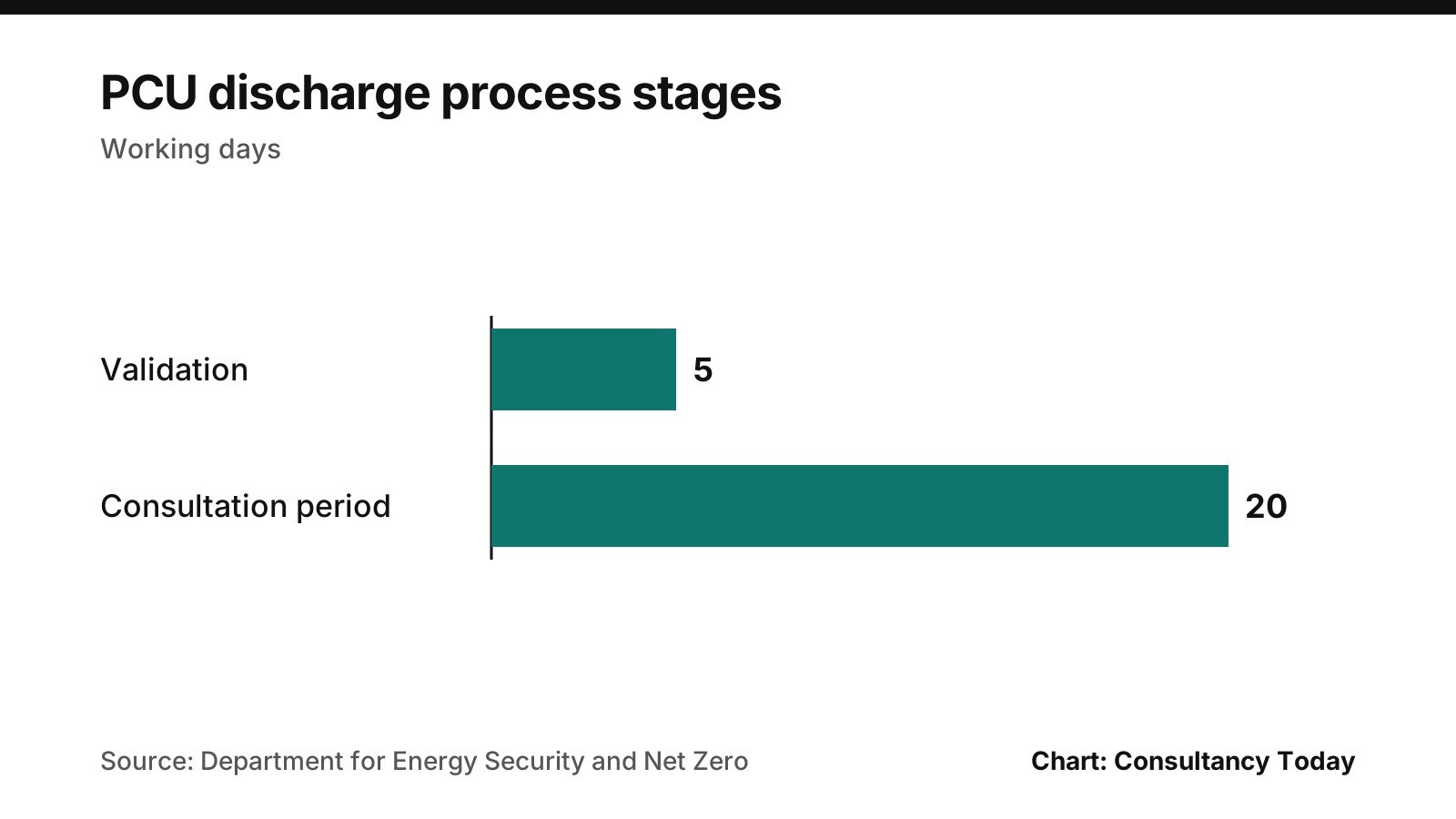
All timeframes in the PCU process are calculated in working days, the guidance said. Where an applicant submits all the required information, validation will take up to five working days.
Consultees will normally have 20 working days, about 28 calendar days, to respond, and may put information requests to the PCU within the first 10 working days of that period. Responses are due by 11.59pm on the deadline day, and the guidance said the PCU reserves the right to treat a consultee that misses the deadline as having given a nil response.
| Stage | Working days |
|---|---|
| Validation | 5 |
| Consultation period | 20 |
At pre-application stage the unit will not review draft documents or hold technical conversations, which the guidance said is to avoid pre-determination.
Fees and compensation
Discharge applications to DESNZ do not currently require an application fee, the guidance said, but the department intends to introduce fees in financial year 2027-28.
The guidance also said local planning authorities and statutory bodies should be compensated for their input, pointing in particular to regulation 12A of the Infrastructure Planning (Fees) Regulations 2010. That regulation, published on legislation.gov.uk, covers fees in relation to the provision of relevant services by prescribed public authorities.
Background
The guidance sits within DESNZ's collection on the consent process for energy infrastructure projects in England and Wales.
The review's naming varies across government documents: the guidance refers to the Nuclear Task Force Review, while the government's response and press releases describe it as the Nuclear Regulatory Review 2025, led by the Nuclear Regulatory Taskforce.
DESNZ said the taskforce's final report, published on 24 November 2025, set out 47 recommendations for the government to speed up building new nuclear projects at a lower cost and on time. The government's response said the Chancellor accepted the principle of all the recommendations at the Budget.
In a letter to nuclear regulators and industry dated 13 March 2026, Rachel Reeves, Chancellor of the Exchequer, said: "We will implement the measures we have outlined by December 2027." The government has separately said all reforms from the review are expected to be completed by the end of 2027.
What happens next
DESNZ said it intends to introduce fees for discharge applications in financial year 2027-28, and the government has said all reforms from the review are expected to be completed by the end of 2027.
On the record: Department for Energy Security and Net Zero
Sources
- Department for Energy Security and Net Zero (GOV.UK) (opens in a new tab) (accessed 2026-10-28)
- Department for Energy Security and Net Zero (GOV.UK) (opens in a new tab) (accessed 2026-10-28)
- Department for Energy Security and Net Zero (GOV.UK) (opens in a new tab) (accessed 2026-10-28)
- HM Government (GOV.UK) (opens in a new tab) (accessed 2026-10-28)
- Department for Energy Security and Net Zero (GOV.UK) (opens in a new tab) (accessed 2026-10-28)
- HM Treasury (GOV.UK) (opens in a new tab) (accessed 2026-10-28)
- HM Government (GOV.UK) (opens in a new tab) (accessed 2026-10-28)
- The National Archives (legislation.gov.uk) (opens in a new tab) (accessed 2026-10-28)
This story was researched from the primary sources above and checked against them before publication. Spotted an error? Tell us and we will correct it promptly.