procurement
Procurement Group hears evidence for early contractor appointment on public projects
Constructing Excellence's Procurement Group, chaired by Trowers & Hamlins partner Rebecca Rees, heard from Scottish Water, the Centre for Construction Best Practice and Professor David Mosey on collaborative delivery and early involvement.
Constructing Excellence's Procurement Group has heard research from the Centre for Construction Best Practice (CCBP) linking later contractor appointment on public-sector projects to higher cost overruns, at a session on collaborative delivery chaired by Rebecca Rees.
Rees, partner and Head of Public Procurement at law firm Trowers & Hamlins, chaired presentations from Paul Sexton, Head of Enterprise Delivery at Scottish Water, Conor Neild Crabb, Head of CCBP, and David Mosey, Professor of Law at King's College London, Constructing Excellence said.
The group's current focus is procurement as an enabler and "procuring for value", according to Constructing Excellence, and membership is open to all its National Members.
The early involvement data
Neild Crabb presented findings from CCBP's research into Early Contractor Involvement (ECI), which Constructing Excellence said analysed 412 completed public-sector projects delivered by 55 contractors and related the timing of contractor appointment to cost and programme performance.
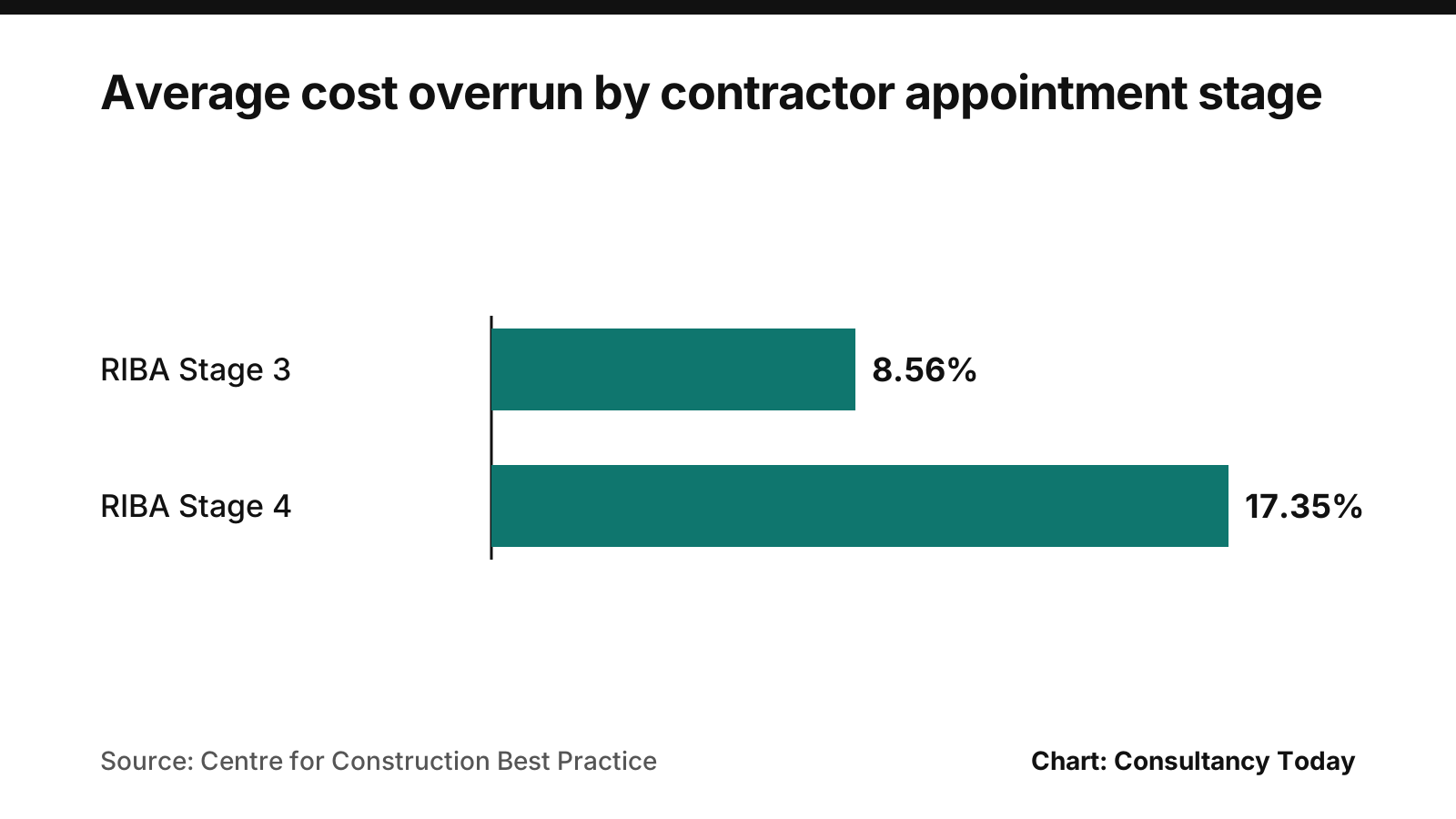
CCBP's own publication of the study, Constructing Certainty, gives the figures behind that message. It found an average cost overrun of 8.56% where contractors were appointed at RIBA Stage 3, rising to 17.35% at RIBA Stage 4.
| Contractor appointment stage | Average cost overrun |
|---|---|
| RIBA Stage 3 | 8.56% |
| RIBA Stage 4 | 17.35% |
On programme, CCBP found that appointment at RIBA Stage 1 correlated with a 7.72% reduction in duration, while later appointment added 11.53% at RIBA 3 and 12.84% at RIBA 4.
Despite this, CCBP said 63% of public-sector contractors are still appointed at RIBA Stage 3 or 4. Its first recommendation is to mandate contracted early involvement by RIBA Stage 2 as the default on public-sector capital projects above £5m, proportionate to risk and complexity.
Mike Reader MP, Labour MP for Northampton South and Chair of the APPG for Excellence in the Built Environment, is quoted in the CCBP publication: "Too often, our procurement system is designed to manage risk through process rather than reduce it through collaboration."
CCBP separately reports that 96% of 412 industry respondents to its sentiment survey support earlier contractor involvement. The study's Industry Advisory Group is made up of senior representatives from BAM, Kier, Morgan Sindall and Wates.
Scottish Water's enterprise model
According to Constructing Excellence's account of the session, Sexton described Scottish Water's move from alliancing to an enterprise delivery model based on Project 13 principles, which he said did not happen overnight.
He used the idea of a "Collaborativometer" to show how organisations progress from transactional contracting through frameworks, partnering and alliancing to enterprise, and said they cannot jump to the most advanced model without doing the groundwork.
That groundwork, the write-up said, included an integrated team pilot on the Improving Urban Waters programme, which brought together consultants, contractors and Scottish Water teams and cut cycle times by 60%.
When selecting enterprise partners, Scottish Water assessed bidders through face-to-face discussions, engagement with staff at different levels of the bidding organisations and board-to-board conversations rather than written submissions alone, Constructing Excellence said.
Gold Standard and the Playbook
Mosey drew on the Construction Playbook and his review Constructing the Gold Standard, which Constructing Excellence said recommends stronger collaborative relationships, early supply chain involvement, shared objectives and a focus on outcomes for public-sector frameworks and framework alliances.
The Cabinet Office published Mosey's independent review of public sector construction frameworks on 16 December 2021. It was commissioned by Lord Agnew with a brief to create a "Gold Standard" for frameworks and framework controls, and a Cabinet Office guidance note summarises its 24 recommendations.
The Construction Playbook, first published by the Cabinet Office on 8 December 2020 and last updated on 11 July 2023, sets out 14 key policies that central government departments and arm's length bodies are expected to follow on a "comply or explain" basis.
What happens next
Constructing Excellence said the Procurement Group will continue to examine collaborative delivery, procurement reform and emerging best practice at future sessions, with details on its events page.
On the record: Scottish Water, Kier, Wates
Sources
- Constructing Excellence (opens in a new tab) (accessed 2026-11-13)
- Constructing Excellence (opens in a new tab) (accessed 2026-11-13)
- Constructing Excellence (opens in a new tab) (accessed 2026-11-13)
- Centre for Construction Best Practice (opens in a new tab) (accessed 2026-11-13)
- Cabinet Office (GOV.UK) (opens in a new tab) (accessed 2026-11-13)
- Cabinet Office (GOV.UK) (opens in a new tab) (accessed 2026-11-13)
- Cabinet Office Procurement Pathway (Civil Service) (opens in a new tab) (accessed 2026-11-13)
This story was researched from the primary sources above and checked against them before publication. Spotted an error? Tell us and we will correct it promptly.