cost data
Only 31% of pharma leaders highly confident of hitting construction budgets, Currie & Brown finds
Currie & Brown's analysis of its 2026 Construction Certainty Index finds pharma and life sciences leaders lack confidence in deadlines and budgets, with 45% reporting cost rises above 10%.
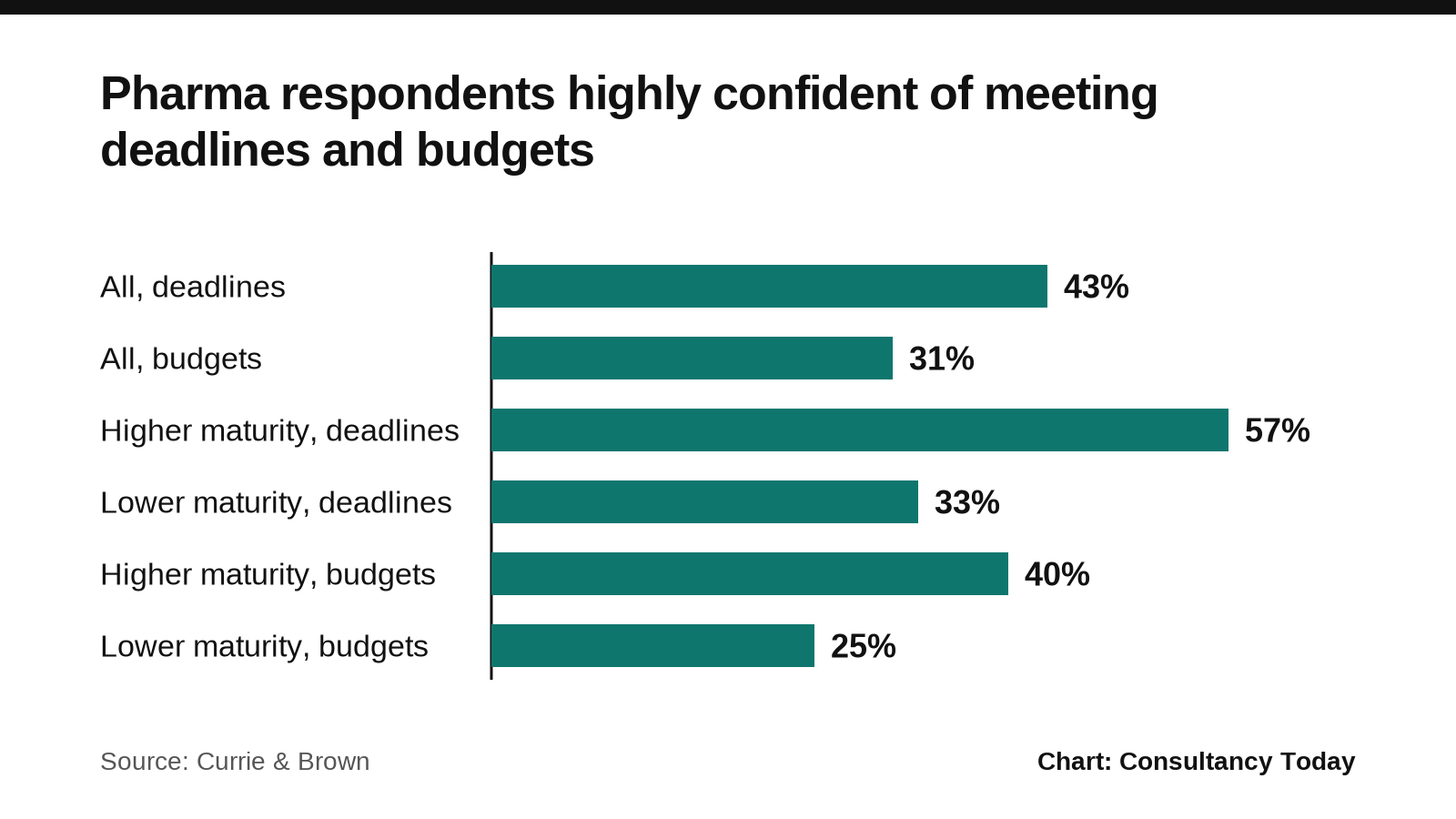
Currie & Brown has reported that only 43% of pharmaceutical and life sciences leaders are highly confident of meeting construction deadlines, and 31% of meeting budgets, in a sector analysis published on 24 November 2026.
The cost and project management consultancy said the findings draw on its 2026 Construction Certainty Index. Almost half (45%) of pharma respondents said uncertainty had pushed up costs across their construction pipeline by more than 10% in the past year.
Steve Townsend, Global Head of Pharmaceuticals and Life Sciences at Currie & Brown, said: "In the current climate, taking time to properly assess risks before construction starts is critical. Leaders need confidence in their costs, programmes and supply chains, but also the flexibility to respond if manufacturing priorities or market conditions change."
The firm said pharma companies are making investment decisions now for facilities that will not be operating for years, and that the findings raise questions about the sector's ability to deliver new manufacturing capacity.
The maturity gap
The research identified five areas it associates with greater resilience to uncertainty: artificial intelligence (AI) for risk management, digital integration, effective data analytics, sustainability embedded in delivery, and investment in skills and training.
Among pharma respondents strong in at least four of the five, 57% were highly confident of meeting deadlines, against 33% of those with lower maturity. Budget confidence was 40% compared with 25%.
| Pharma respondents | Highly confident (%) |
|---|---|
| All, deadlines | 43 |
| All, budgets | 31 |
| Higher maturity, deadlines | 57 |
| Lower maturity, deadlines | 33 |
| Higher maturity, budgets | 40 |
| Lower maturity, budgets | 25 |
Currie & Brown's full analysis defines highly confident as very or completely confident. It found 41% of pharma and life sciences respondents showed at least four of the five maturity markers, compared with 32% across all sectors.
Gaps remain, the firm said. Almost half (47%) of pharma respondents reported limited access to real-time data, and 41% struggled to integrate information from different sources. While 54% said AI and digital integration influence several delivery stages, only 18% said they are central to how assets are designed, built and operated.
Cost and skills pressures
The full analysis reported that 76% of pharma respondents cited material cost inflation as a factor and 63% cited supply chain disruption. Half said skills shortages had delayed at least a quarter of their construction projects in the past year.
Townsend said: "Organisations investing in better data, risk management and skills report significantly greater confidence in delivery. Strong preparation gives businesses the confidence to commit capital, while keeping their options open when circumstances change."
Currie & Brown set out three priorities for strengthening delivery certainty: building flexibility into investment planning, assessing specialist skills and resource availability early, and using reliable, connected data to anticipate risks.
The wider index
According to Currie & Brown's 2026 Construction Certainty Index page, the index draws on more than 1,300 construction and infrastructure decision-makers worldwide. Across all sectors, it found uncertainty had increased construction pipeline costs by an average of 12.4% over the past year, which the firm said equates to almost US$2 trillion of forecast global construction spending in 2026. Respondents across all sectors estimated that 31% of potential projects had not started or progressed.
In the firm's 2026 global cost report, pharmaceuticals scored 58 overall on the index, which rates delivery confidence from 0 to 100. Its sub-scores were 67 for time and budget, 43 for risk, 54 for sustainability, 42 for technology adoption and 63 for AI impact.
The first index was launched on 30 September 2025 under the title Building certainty in an era of relentless change. That edition estimated uncertainty would wipe $2.5 trillion from global construction activity in 2025, with respondents reporting losses equal to 13.7% of their pipelines.
The full analysis cites Eli Lilly breaking ground on a $6.5 billion manufacturing facility in Houston in September 2026, and Novo Nordisk's €432 million investment to upgrade and expand its Athlone facility in Ireland, as examples of the investment boom.
Background
Currie & Brown announced Townsend's appointment on 8 January 2026, when it described the role as Global Head of Pharmaceutical Sector. He is based in the UK, has more than 30 years of experience in capital programme delivery and was previously Global Head of Project Controls at GSK.
The consultancy was founded in Glasgow in 1919 and has more than 70 offices and over 2,600 people. In the UK pharma sector it provided project management and project controls services on the Vaccines Manufacturing and Innovation Centre at Harwell.
The findings are set out in the firm's sector analysis, Does pharma's investment boom have a delivery problem?
Sources
- Currie & Brown (opens in a new tab) (accessed 2026-11-24)
- Currie & Brown (opens in a new tab) (accessed 2026-11-24)
- Currie & Brown (opens in a new tab) (accessed 2026-11-24)
- Currie & Brown (opens in a new tab) (accessed 2026-11-24)
- Currie & Brown (opens in a new tab) (accessed 2026-11-24)
- Currie & Brown (opens in a new tab) (accessed 2026-11-24)
- Currie & Brown (opens in a new tab) (accessed 2026-11-24)
- Currie & Brown (opens in a new tab) (accessed 2026-11-24)
This story was researched from the primary sources above and checked against them before publication. Spotted an error? Tell us and we will correct it promptly.